Sunday, November 15, 2015

Minnie Keohane - my grandfather's older sister

We saw that Minnie Keohane was born in 1888. 


Aunt Nellie pointed out a cottage by the side of the road where her sister Mary or Minnie was born – I think it was on the Battle Road. This was just one of the cottages were the family lived.


We know that Minnie was keeping house for her family in 1901 after her mother died - she was only 13.


Maternal and infant mortality were high in these days - heck, it was high in the first part of the twentieth century! So mothers knew that there was a possibility that they would die in childbirth. So they began teaching housekeeping skills to their daughters at a very young age in case anything happened to the mother - the daughter(s) could take over. This seems to be exactly what happened with our family.

Minnie was not living with the family in 1911. I guess her father, Patrick Keohane, remarried soon after the 1901 census judging from Minnie's half sister Julia's age - she is 8 years old in 1911 - so she was born about 1903? This was shortly after the earlier census.

So I wonder when Minnie left home? I couldn't find her in the 1911 Irish cenus for Cork. When did she leave home and where did she go?


We know that Minnie ends up in London, but I couldn't find any information about her until I found an index for marriages from October to December 1915. It lists Robert Banham marrying Keohane - not even a first name!! - in Wandsworth District - volume 1 d - page 2038. Wandsworth forms part of inner London. 

I presume this is our family - I know from family history that Minnie's husband is Robert Banham from England. Their daughter Theresa told me that her father swept Minnie off her feet.

And this might be our family - Robert Banham was born in 1889 in Battersea, London - I think it says on July 10, and he was baptized July 14 - but look and see what you think. His father was Frederick and his mother was Susan Banham.  His address looks like 58 Cheltam Road in Battersea, but I can't find that street on a map. Areas of Battersea were redeveloped several times so the street may no longer exist. The baptism took place in the parish of St. Michael's Church in the county of London, and A. W. Houghton, the assistant curate, performed the ceremony.


The Church's website - http://stmichaelsbattersea.org/church-building/ provides this information:


The History of St.Michael’s
In the early 1880s, following the construction of the railway, the farmland of this part of Battersea was re-developed as a residential neighbourhood. The Vicar of Battersea, Canon John Erskine Clarke, worked hard to raise the funds to build a number of churches to serve the area. He also commissioned the Bolingbroke Hospital.
St.Michael’s began as a temporary mission church in 1872. The present building was dedicated in 1881 ... 
The Building
The church was designed by William White, one of the leading church architects in Victorian times. Although the cheapest materials were used, the interior of the church is both gracious and beautiful. The architect H.S.Goodhart-Rendel, a keen advocate of the Gothic revival, once commented of St.Michael’s, “Everything very honest and thoughtful.” 
Special features include the font, the clerestory windows, the reredos, rood screen and pulpit. The angels on the wooden pulpit were carved by Hems, and the stained glass windows were designed by Lavers, Barruad and Westlake. The organ is a particularly fine example of Henry Jones’ work. 
A school was added to the building in 1887-88, which is now used as the church halls."


I couldn't find a better picture than these.


The interior of Church of England's St. Michael's Church 

I went to the Falmouth Library to use the library edition of www.ancestry.com. The 1891 census of the civil parish of Battersea, the ecclesiastical parish of St. John, county of London for 34 Mendip Road shows a Banham family living in 2 rooms. Frederick Banham is the head of the family - he is about 37 years old and works as an excavator. He was born in Skepney in London. His wife Susan is 26 and was born in Easton in Hampshire. Daughter Maria is 5 and was born in Wandsworth, London. Frederick is 4 and was also born in Wandsworth. Our Robert is 9 months and was born in Clapham, London.

I found a Robert Banham listed in the 1901 census of England. He is an 11 year old "inmate" at Macclesfield Certified Industrial School for Boys on Brook Street, Macclesfield, Cheshire. His profession is a scholar. I don't know if this is our Robert, but it is the only Robert I found. 


Bob Banham and his two sisters.

So Robert and Minnie marry sometime between October and December 1915 in Battersea which is an area of London lying on the south bank of the Thames riverFor Americans it is notable because Revolutionary War traitor Benedict Arnold, his wife and daughter are buried in a crypt in St. Mary’s Church. 

Minnie was about 25 when she married. I wonder if any of her family was present - Aunt Nellie maybe? And did they marry in Robert's Church of Ireland or Minnie's Catholic Church? I guess I'll have to send for the marriage certificate.


I love this picture of Minnie. I don't know when it was taken. 


Battersea is at the bottom left of the map - the red icon.


http://www.allinlondon.co.uk/regions/battersea/ describes Battersea as follows:

"Battersea is located in the London Borough of Wandsworth and is situated in South West London. Considered very much inner city London, Battersea is less than 3 miles away from Charing Cross, making it readily accessible from just about any part of Central London.  

Battersea’s most famous landmarks are Battersea Power Station, famously depicted on the cover of Pink Floyd’s ‘Animals’ and the sprawling Battersea Park, frequent host to funfairs and other events throughout the year, and let’s not forget Battersea Dogs and Cats Home, the UK’s most well-known animal sanctuary. 

Considered by some to be designated for Chelsea’s residential overspill, Battersea has in fact existed since Saxon times; Lavender Hill is so-called because up until the Industrial Revolution the area’s main business was the production and sale of flowers, fruit and vegetables. Today Battersea is a relatively affluent neighbourhood with wine bars and gastropubs galore, as well as the splendid Battersea Arts Centre which has an eclectic programme of music and theatrical events." 


Cover of Pink Floyd's Animals


"By the late 19th century Battersea had developed into a major town and railway centre. The effect of this was that a population of 6,000 in 1840 had increased to 168,000 by 1910 and, except three parks, farmland was built over for railway sheds and tracts of housing. The creation of Battersea Park by the Crown in the mid 19th century also marked a turning point for the area when housing was built in the south and west. The peak of building here came in the 1880s and 1890s, with the construction of Queen Anne style houses, mansion blocks and cottages. 
In the south of the area, the streets surrounding Northcote Road have well preserved Victorian terraces. World War II bomb damage led to a large part of the industrial riverside area being swept away in a vast rebuilding plan. At the same time the industries west of Albert Bridge began to close or relocate, with apartment blocks now filling both areas. There remains a wealth of period conversions in Battersea, and a selection of complete Edwardian homes and Victorian villas, as well as a stock of ex local authority flats and terraces. Battersea Square offers a stock of mansion blocks and riverside apartments."

Battersea Park with Power Plant in background


The Register of Electors of 1918 for the Parliamentary Borough of Battersea's North Division lists #4480 Mary Banham and # 4481 Robert Banham living at 61 Winstanley Road. Mary is qualified to vote in Parliamentary and Local elections by her husband's occupation. Robert is qualified to vote due to being a Navy or Military voter.  


The above map shows how close to central London the Banhams were living. The picture below is an aerial view of the current neighborhood.


Bob and Minnie's first child, Irene Banham, was born in 1918 - she was likely born while they were living at 61 Winstanley Road. 


Frederick (Freddie) Banham, below, was born in 1920. According to the Electoral Registers, the Banhams lived at 109 Winstanley Road in 1923. So I am not sure where the family was living when Freddie was born.


But they moved to 2 Raywood Street in Battersea by 1925 and are listed here through 1929.  I couldn't find Raywood Street on any map - when I put the address in, Newton Prepatory School popped up. Perhaps Raywood Street was razed during a redevelopment.


The Banham family is living at 4 Latchmere House in Latchmere Wood in 1933. I can't find this on a map - there is Latchmere Road and Latchmere Close in two different areas of Battersea. The family is listed living here until 1956.

Theresa Banham is born 9 September 1930 in Battersea. I don't know if the family was living at 4 Raywood Street or 4 Latchmere House.


"The Latchmere Estate, opened in August 1903, was the first council estate in Britain to be built by direct labour – by the Council’s own workforce.
An area of allotments on the former Latchmere Common had long been identified as potential building land but it took the perseverance of Burns (Member of Parliament) and others to secure acts of parliament in 1899 and 1900 which finally granted the right to build.
The dwellings were novel of their kind, containing as they did what had once been regarded as luxuries, such as baths, combined ranges and electric light. Not many working men had such accommodation in which to bring up their families, but the Battersea Borough Council had come to the conclusion that such accommodation was an absolute necessity.
The provision of electric lighting was particularly controversial. There were those who did ‘not see why the working people of Battersea should be allowed electric light at all: it [was] a luxury…which should be confined to the well-to-do’.(1)  The Council’s pragmatic response was that the scheme was self-supporting.
That electricity was supplied from the Council’s own generating station whilst the Estate’s water supply came from an artesian well sunk by the Council which served the adjacent Latchmere Baths ...
315 dwellings were provided in total: 28 five-room houses, one four-room house, 70 houses each with two three-room tenements with bath scullery and 73 houses each with two four-room tenements with bath scullery. Each tenement had its own entrance and its own back garden (with stairway access in the case of first-floor tenements). Of 11 acres, three were preserved as open space."


Theresa was young during the Nazi Blitzkrieg of England - she told me that she remembered hiding under the kitchen table during one raid.

"On 4 September Hitler, frustrated by the RAF's superiority over the Luftwaffe and enraged by its bombing of German cities, vowed to destroy the British capital and the spirit of its people.
In response, the Luftwaffe shifted its focus from attacking RAF Fighter Command's bases and communications networks to bombing Britain's cities. Hermann Goering, the Head of the Luftwaffe, had severely lost face over both the bombing of Berlin, and his force's failure to defeat the RAF. He hoped that the intense bombing of British cities would both destroy public morale and draw the remaining RAF fighters into battle and annihilation.
The bombing begins
After a preliminary raid on 5 September, the bombing started proper on the afternoon of the 7th. Almost 1,000 German aircraft - over 300 bombers escorted by 600 fighters - crossed the Channel. It was the largest collection of aircraft ever seen. Fighter Command had not expected raids on London, but now attempted to intercept the waves of bombers. A huge dogfight developed over London and the Thames Estuary. 
Convinced that the German invasion of Britain was imminent, the country was put on the highest alert. Signals of impending invasion went out - the code word "Cromwell" was sent to military units and church bells rang.
Some of the German bombs did fall on their intended target of the docks, but many fell on the residential areas around them. Substantial parts of East and South-East London were devastated, 430 civilians were killed and 1600 seriously injured. Firestorms ravaged the city, acting as beacons for the second wave of bombers that evening.
After the raids Winston Churchill shared the public's fury and defiantly announced: "He [Hitler] has lighted a fire which will burn with a steady and consuming flame until the last vestiges of Nazi tyranny have been burnt out of Europe".
Bombing continues for the next 76 nights

Although no-one knew at the time, this was the beginning of the Blitz. With the exception of one night, when the weather was bad, the bombing continued for the next 76 nights consecutively, with daytime raids as well. Liverpool, Manchester, Swansea, Cardiff, Bristol, Southampton were also targeted."

http://www.bbc.co.uk/history/events/germany_bombs_london  reports that from 7 October 1940 to 6 June 1941 the German Luftwaffe dropped 738 high explosive bombs in Wandsworth, the borough in which Battersea is located. The map below shows where those bombs dropped. This website also has memories of people who lived during the Blitz - they are amazing. Take a look at  them.


The map below shows where 29 bombs fell in Latchmere during WWII from 7 October 1940 to 6 June 1941. There are more interesting memories of the war on http://www.bombsight.org/explore/greater-london/wandsworth/latchmere/ where I found this map.


Winston Churchill inspecting damage in Battersea from Nazi bombs on 10 September 1940.    http://www.bbc.co.uk/history/events/germany_bombs_london

As far as I know, the Banham family survived the war without injury.


Theresa said this is her sister Irene’s son John, Irene’s husband Charlie, Madge Keohane (Uncle Jim Keohane’s daughter), Minnie Keohane Banham, Aunt Nellie Keohane, Freddie Banham and Minnie’s husband Bob Banham in the back.


 Minnie Keohane


Freddie, Iris, their sons and the sons' girlfriends.


Freddie Banham


Freddie and Iris and a family relative.


Iris, Fredie, and Theresa


Theresa, her brother Freddie, her husband Johnny, and Freddie's wife Iris.


Freddie and his granddaughter


Theresa and her two children   


Josie Keohane Nelson (Uncle Jim Keohane's daughter,) Hannie Keohane Huliston, Theresa Banham Vespa, and Rita Keohane Walsh kicking up their legs in Hannie's living room in Watertown during one of Theresa's trips from Montreal to visit her cousins. Theresa and Johnny would drive down and spend several days at Hannie's.


Theresa with Hannie's daughter Joan and Joan's grandson at Hannie's.


Theresa Banham Vespa


Rita Keohane Walsh and Theresa at Hannie's. Theresa loves to sing and enjoys a good joke.


guess my aunt Rita Keohane and her husband Dick Walsh stopped off in England for a visit with Freddie Banham before they went to Scotland. Unfortunately, I don't know what year it was. Here is the letter from Freddie to them.


"383 London Rd.
Aylesford
Maidstone Kent
England
ME207QA

19th Oct.

Dear Rita & Dick,
I'm sorry it's been so long in replying to your letter, but we have had problems. We went to the Canary Ilse Spain on the 26th of June for a fortnight vacation, and had only been in our apartment 6 hours when Iris cut her leg badly on the sharp edge of the wooden bed frame.
We called the doctor who took her to the hospital at once and after treatment she was allowed to the apartment, but we had to attend the Hospital for treatment every day and we are still visiting our own Doctor based in the U.K. after 14 weeks since it occurred.
I am pleased to say that the wound which was in the shin bone area
                                                                     PTO (Please Turn Over)


"is almost closed and it will be nice not to have to visit the surgery so often.    I'm glad you enjoyed the scenery in Scotland, as you say it's out of this world. I('m) glad you enjoyed a drink in the Scotch pub, not many years ago, you could not have a drink in a Scotch pub or Hotel on a Sunday less you could prove you were a traveller. I'm pleased Aunt Nellie likes her rosary beads & glad she's doing well. I have phoned Terry recently & she's had a slight accident in the car but she sounds O.K.
We (are) very pleased you enjoyed your day out with us. Myself & Iris loved your company - after all we like to show our Capitol City off. Plus our lovely County of Kent. God Bless you & Dick & give my love to Aunt Nellie.
Love Iris & Freddie
Please excuse writing. I am just getting over the flu."


Bob Banham died 28 December 1955 in Battersea. On www.ancestry.com, I found an index to Battersea District deaths 

from October - December 1955 - volume 5 page 15. The death was registered in the civil parish of Battersea, ecclesiastical parish of St. John, in the county of London - registration district of Wandsworth for West BatterseaBob was 66 year old when he died.


Minnie also died in Battersea, London – I believe she died in a fire.


Monday, November 2, 2015

Aunt Nellie Keohane - her early life.

I sent for Aunt Nellie's baptismal record for our family reunion in 2006. It states that Ellen Keohane is born 25 June 1893 in Kinsale. She is baptized two days later in St. John the Baptist Church in Kinsale. Her parents, as we know, are Hannah Kiely and Patrick Keohane.

One of the sponsors is James Keohane who is probably Patrick Keohane's brother - this is the brother who dies of sunstroke out in Somerville in 1896 - 13 years after Aunt Nellie is born. No wonder she remembered him.

The other sponsor is Margaret Spillane. There are a couple of Margaret Spillanes on www.irishgenealogy.ie, but I don't have enough information to make a guess if any of them are Aunt's Nellie's Godmother. 


One day when she was small, Aunt Nellie's mother told her to mind the turkeys while she went into town. While her mother was in town, one of the turkeys got away and ran into the branch of a tree - breaking its thin neck!! Aunt Nellie was afraid that her father would find out and kill her. She hid the turkey under a bush until her mother came home. Her mother told her that everything would be alright. Maybe they had turkey for dinner!

I have Aunt Nellie on tape saying that her father used to say “Nelleen, you look just like Nell Leary. I (Aunt Nellie) used to be below at the fire.” Her maternal grandmother is Nell Leary Kiely – Hannah Kiely’s mother. Aunt Nellie said that when her grandmother died, Nell Leary was in or past her mid 90’s. 

We know that Nell's daughter and Aunt Nellie's mother, Hannah Kiely, dies young - around the time of young Jim Keohane's birth in 1898. The census showed us that Patrick Keohane is a widower in 1901, and young Minnie Keohane is the housekeeper. Aunt Nellie is 6 years old and is going to school. 


Back in these days the local pub and shop are the places people go not only for groceries or a pint, but also to find out the local news and to find out what is going on in the rest of the county and the world.  There were no TVs or radios - not everyone could read or even afford a newspaper. 

The Dunderrow Pub - now The Field Pub - was the local pub. Aunt Nellie used to talk about how the Keohane children used to hide under the bed or kitchen table when they heard their father Patrick Keohane coming home drunk from the Dunderrow Pub. She always hated that pub. I'm sure that she would be horrified that many of her grandchildren and great grandchildren have enjoyed a pint there.


1987 - Patrick Breen, Christine Manning Breen, John Huliston, and Joanne Manning 


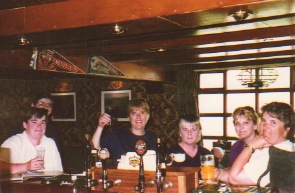
Aunt Nellie's great nieces in Dunderrow Pub - left to right, Christine Manning Breen, Joan Huliston Vachon, me, Patricia Manning Schiavoni, and Diane Huliston Pierce. Great great nephew Rick Schiavoni is behind Christine. ? 1997


Another trip to Dunderrow Pub - Dan Murphy, Rick Schiavoni, and Patricia Manning Schiavoni.

Aunt Nellie also said that after her mother died, Patrick Keohane used to bring home women from the Poor House (run by the Poor Law Union of Kinsale.)  These women used to keep house and look after his children. Aunt Nellie said that she and Aunt Hannah used to poke the women with a hat pin.  They were small – they wanted their mother not these strangers.

Aunt Nellie also talked about her brother, young Jim Keohane, being locked out of the house one night by his father when he was a teenager because he was late coming home. Aunt Nellie said their mother, Hannah Kiely Keohane, appeared to her, and showed her that she (their dead mother) covered Jim with a cloak, and watched over him that night while he slept outside in a ditch.

Once a week no matter what the weather, "little Nell" had to walk into Kinsale to deliver eggs to the Acton family home. Acton’s Hotel is the original home of the Acton family who settled in Kinsale in 1860. They developed a number of businesses in Kinsale. Sydney Acton opened a family hotel on this site in 1946. Aunt Nellie said that when she returned to Kinsale she always stayed at Acton’s Hotel. I wonder what she thought about the days she used to deliver the eggs to the Acton family - as she laid in bed in their hotel!! She paid for me to stay there the first night we were in Kinsale in 1981.


Back: Rita and Michael Walsh, Joanne and Ellen Manning
Front: Aunt Nellie and John Manning outside at Actons's


The 1911 census does not list Aunt Nellie in the Keohane household. She must be out working.


Aunt Nellie told me that she worked for a local farmer and his brothers – they were single. Nellie said that she had “to empty their shit pots every morning.” Remember there was no indoor plumbing in those days. I think she pointed out the farm as up to the left as you face Dunderrow Pub.

I found an 18 year old Ellie Keohane working for the Bradfield family in Leighmoney More in 1911. Benjamin Bradfield is the 35 year old head of the family - he is a steward. I wasn't sure what a steward was. 

According to http://www.historyhome.co.uk/c-eight/ireland/ire-land.htm, most substantial proprietors (land owners in Ireland) employed land stewards to manage their lands. I'm more used to the term land agent.

http://www.aughty.org/pdf/estate_own_manage.pdf tells us that 

"On absentee estates a great deal depended upon the efficiency of the estate agent. In general, the employment of agents (except in the case of smaller estates managed by their owners) was the most common form of estate management in nineteenth century-Ireland. Some of the greater estates employed a number of sub-agents supervised by the chief agent who, in turn, was accountable to the landlord himself. Agents were responsible for collecting rents (which were usually collected twice a year on appointed gale days in May and November and often in local hotels or estate offices in nearby towns) as well as eliminating arrears; keeping accounts; drawing up leases and ensuring that their covenants were adhered to by the tenants; supervising estate expenditure; overseeing improvements; carrying out evictions; and valuing property. They often had to ... seek abatements of interest on existing liaise between landlords and tenants, receiving petitions from tenants, particularly for reductions of rent [5]. Land agents were responsible for all aspects of estate administration and in the final analysis for managing expenditure on estates in their charge.[6]
Besides his estate duties, an agent often served as resident magistrate, represented his employer at poor law guardian meetings or organised voters at elections. Because of the importance of these functions and the moderate financial rewards on offer (an agent's normal income was 5 per cent of rents collected but a fixed salary of £800 to £1,000 per annum from single estates was not unknown), the profession attracted younger sons of landlords throughout the nineteenth century. Agents were often local solicitors, retired army officers, or wealthy gentlemen.
Other more routine administrative duties on an estate were carried out by bailiffs, stewards and agriculturalists."

Also in this house is Elizabeth Bradfield - she is Benjamin's 30 year old sister. She has no occupation. And look - Benjamin has two brothers - John, 28, and Willie, 24. Both are farm servants.

The family is Church of Ireland - they all can read and write - they are all single - they were all born in County Cork.

So this must be Aunt Nellie and the brothers for whom she had to do such foul things as empty their chamber pots! I suppose she had to empty the sister's pot as well!


Map shows Leighmoney More - note Bradfields near the top above Horsehill Beg. I suppose the Bradfields lived near there?


This next form shows us that in 1911 W. H. Heard is the landowner where Benjamin Bradfield was living. The house where the Bradfields live is a first class house with 10 rooms and 10 windows in front. Mr. Heard also owns the gate house lodge which is unoccupied. So Benjamin Bradfield must work for Mr. Heard.


The other two neighbors are William Seymour who owns his land and Timothy Coffey who must be renting his house from William Seymour.


If we take a quick look back at the 1901 census, we see that 60 year old widow Catherine Bradfield was the head of the family - she was listed as a housekeeper, domestic servant. Her 4 sons were listed as farm servants - James was 35, Benjamin was 30, John was 20, and William was 17. Daughter Eliza, 27, was listed as a general domestic servant. None of her children were married at that time. And except for James who is not listed, none of them are married in 1911.


From the following form, the family is in a house with 10 windows in front, and they occupy 10 rooms. But in 1901 the landowner is Emily A Pratt. I wonder if she sold the place and land to William Heard? I wasn't able to find anything about this gentleman.


Aunt Nellie also worked for a farmer who lived near where the chemical plant is located now. It may have been here that she worked with her best friend and first cousin Mollie Reardon from nearby Horsehill Mor.  She told me a story about finding this farmer dead - she called Mollie - neither wanted to tell the wife - I think it was the wife who sent one of them for help – the other had to sit with the body. Unfortunately, I don’t remember the exact details now, but Aunt Nellie was laughing telling me, and it was funny when she told the story.

I looked at the 1911 Irish Census for Ballythomas East, but the three families residing there - the two Desmond families and the Ahern family - live in 2nd and 3rd class houses - they also have families so I eliminated them as the couple for whom Aunt Nellie worked.

So I looked at the 1911 House and Building Return for Ballythomas West again. We saw that Patrick Keohane owns his 2nd class house - this is the house that his son John Keohane bought for his family before he emigrated.

Now look at house #2 which is owned by Daniel Bowen. It is a private dwelling with 11 farm buildings - it is a first class house with 7 rooms and 6 windows in the front. A good size house!
Daniel Bowen also owns the land where the Patrick Sweeney family is living in a 3rd class house - probably made of mud with a thatched roof. Patrick likely works for the Bowens.

I wonder if this is the farmer and his wife for whom Aunt Nellie and Mollie Reardon worked?


The individual return lists 60 year old Daniel Bowen as head of the family - he is a farmer. His wife is 50 year old Mary Anne Bowen. They are both Roman Catholic and are able to read and write. They have been married for 24 years. The next column reports that they have had no children born alive. I wonder if that means that Mary Anne was never pregnant? or if it means that she never had a successful pregnancy? 
Both Daniel and Mary Anne were born in County Cork.


Look at this farm building return for the Bowens - neither the Keohanes nor Sweeneys had any farm buildings while the Bowens had: a stable, a coach house, a cow house, a calf house, a dairy, a piggery, a fowl house, a boiling house, a barn, a potato house and a shed! I guess they could afford to pay for a couple of servant girls.


If we look back to 1901, it looks like the Bowens were living in the same 1st class 7 room house. Daniel Bowen owned the land where the Patrick Sweeney family was living in a 3rd class dwelling. They were the only two families living in Ballythomas West.  Makes me wonder how John Keohane got the house - did he buy it from Daniel Bowen?


If we look at the listing for the family in 1901, the head of the family is Daniel Bowen, 46. His wife is Maryanne Bowen, 40.  Daniel's aunt Johannah Bowen is 68 years old and is living here also - she is widowed. Interesting that the family's general house servant Mary Ahern is 70! I presume that Aunt Nellie would have worked for them after the aunt and the servant died - she never mentioned either.


Aunt Nellie eventually goes to England to find work - maybe she was tired of emptying chamber pots! She stayed with her sister Minnie at some point. Aunt Nellie told me that she liked living in England - there is something in my memory that she worked at a hospital or a home for soldiers. Aunt Nellie said she was not happy when her brother John Keohane saved the money for her passage and instructed her to come to Boston. I know she told me that she did not want to go to America, but her brother insisted. 

http://ezitis.myzen.co.uk/thirdlondon.html tells us that:


"There were many private hospitals for Officers funded directly by donors that were not controlled by the County Director. Those asterisked are accepted by the War Office through the Red Cross." 

One of those asterisked hospitals was  "*9, Cedars Road, Battersea."  I noted this one in particular because Battersea is where Minnie Keohane is living - and I think Aunt Nellie went to Minnie when she went to England.


  • Over the course of the war, numerous country estates and London mansions were converted into hospitals and convalescent homes for military casualties or as temporary lodgings for the scores of Belgian refugees who escaped their occupied country in 1914. At the Duke of Bedford’s Woburn Abbey, the riding school and indoor tennis court were converted into a 100-bed hospital, and Blackmoor, the Hampshire home of the Earl and Countess of Selborne, was converted with the countess as commandant, and the drawing room, dining room and smoking room turned into wards, the hall into the men’s living room, the library as the nurses’ sitting room, and the billiards room became a store (not until Easter 1919 was the home turned back to its pre-war appearance). Even Highclere Castle was converted to hospital use, with the Countess of Carnarvon turning to her (rumored) biological father, Alfred de Rothschild for funds with which to equip her home with the finest service. 
    According the present Lady Carnarvon (of Highclere Castle) in an article in The Telegraph:
    Thirty nurses were recruited. The family’s personal physician was hired as medical director. Arundel, a bedroom on the first floor in the northwest corner of the house, became an operating theatre. All the castle’s 41 south-facing rooms had to be fitted with exterior blinds. And when the men started to arrive, “it was like moving a house party of 50 people into the castle on a permanent basis” – with the same number of staff. 
    Not all estate owners were as generous: Lord Wemyss declined his wife’s suggestion to turn Stanway into a hospital, and even threatened to close the house altogether! This reaction was rare, however, and both nurses and owners of great estates experienced many traumas and hardships on the Home Front, which did much to shake up Edwardian society."
    As we know Highclere Castle, mentioned above, is the setting for Downton Abbey.

     http://cdn.cstatic.net/images/gridfs/5491d9d9f92ea1603c00a0bf/Highclere-Castle-1024x682.jpg


    "Role of the British Red Cross

    One of the many important services that the Red Cross provided during the First World War was auxiliary hospitals and convalescent homes for wounded servicemen. The Red Cross prepared for this before the conflict even began, finding some suitable properties that could be used as hospitals should war break out. However, they did not anticipate how important this service would be in the recuperation of so many servicemen.
    As soon as wounded men began to arrive from abroad the Red Cross’ temporary hospitals were largely available for use, with equipment and staff in place. 

    Hospital personnel

    Auxiliary hospitals were usually staffed by:
    • >  a commandant, who was in charge of the hospital except for the medical and nursing services
    • >  a quartermaster, who was responsible for the receipt, custody and issue of articles in the provision store
    • >  a matron, who directed the work of the nursing staff
    • >  members of the local Voluntary Aid Detachment (VAD), who were trained in first aid and home nursing. 

    • In many cases local women from the neighbourhood volunteered in the hospitals part-time, although it was often necessary to supplement voluntary work with some paid roles, such as cooks. (Aunt Nellie perhaps?)
      Auxiliary hospitals drew on members who were too old or young for work in a military hospital. Many were unable to leave home for six months due to family commitments, but were willing to sign a three-month hospital contract. Auxiliary hospitals also attracted members who found work in a military hospital too strenuous and others who ‘preferred to be head cook in a small auxiliary hospital to assistant cook in a large military hospital’. (Now this sounds like Aunt Nellie!)


    Anyway, Aunt Nellie not so happily leaves Liverpool 8 May 1920 on the S.S. Caronia and docks in New York 18 May 1920. She is a 25 year old single housemaid. She is able to read and write; she speaks English. She is from Ireland and is an English citizen. Her last permanent address is London, England. Her nearest relative in England is her sister Mrs. Bennett of 61Winstanley Road in Battersea. Her final destination is Boston, Massachusetts. 
As we already saw, this sister is Minnie Keohane Banham -      not Bennett.


Nellie has a ticket to her final destination – she paid for part of it, her brother paid for part of it. She is joining her brother J. Keohane, 17 Adams Street, Boston, Mass. Nellie has not been in the U.S. before, but she does not intend to return to Ireland. She plans to remain in the U.S. permanently and become a citizen. She is in good physical and mental health.  She is 5’4” – she has a fresh complexion with brown hair and brown eyes. She was born in Kinselle.


http://www.clydesite.co.uk/clydebuilt/ships/1905/CARONIA_362.jpg

The S.S. Caronia was a Cunard Line ship that was built in Clydebank, Scotland. I found it interesting that she was the first ship to send a warning to the S.S. Titanic about the ice fields and icebergs that the Titanic was approaching.

So Aunt Nellie went through Ellis Island. Did anyone meet her there? How did she know where to go to get to Boston?

I know that Aunt Nellie was Godmother to my mother, Ellen Keohane Manning, in 1921 - a year after she arrived in the United States. So she made it safely to Boston!!